A quadratic through two given points is the chord plus $a(x-p)(x-q)$
Idea
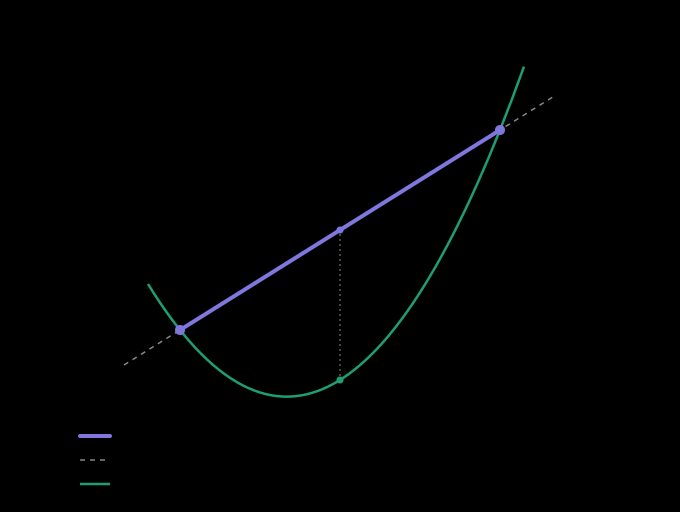
Fixing two points on a parabola leaves one degree of freedom: how much of $(x-p)(x-q)$ — zero at both points — is added to the straight line through them. One more condition, of any kind, then pins the quadratic down.
Definition
If $g$ is quadratic with $g(p)=P$ and $g(q)=Q$, then
$$g(x)=a(x-p)(x-q)+\ell(x),$$
where $\ell$ is the line through $(p,P)$ and $(q,Q)$ and $a \ne 0$ is the leading coefficient. The chord (현) is the segment joining the two points; $\ell$ is the whole line through it, the secant (할선).
Why it holds
$g-\ell$ has degree at most 2 and vanishes at $p$ and $q$, so it is a constant times $(x-p)(x-q)$. Through the remainder theorem (나머지정리), $\ell$ is the remainder of $g$ divided by $(x-p)(x-q)$. Any degree works the same way: two polynomials that agree at $x_1,\dots,x_k$ differ by a polynomial multiple of $(x-x_1)\cdots(x-x_k)$.
At the midpoint $m$, with half-width $h=\tfrac{q-p}{2}$, the product equals $-h^2$, so $g(m)=\ell(m)-ah^2$: a value there reads off $a$ directly.
Example
Through $(0,1)$, $(2,5)$ and $(1,0)$: the chord is $\ell(x)=2x+1$, and $x=1$ is the midpoint, so $0=\ell(1)-a=3-a$ gives $a=3$ and $g(x)=3x(x-2)+2x+1=3x^2-4x+1$.
Pitfalls
$a=0$ returns the chord itself, which is not a quadratic — discard it when the problem demands degree 2.
Starting from $ax^2+bx+c$ also works, but spends two of the three equations rediscovering the chord.
See also
A piecewise bijection fills each gap in the range exactly — in either direction