A piecewise bijection fills each gap in the range exactly — in either direction
Idea
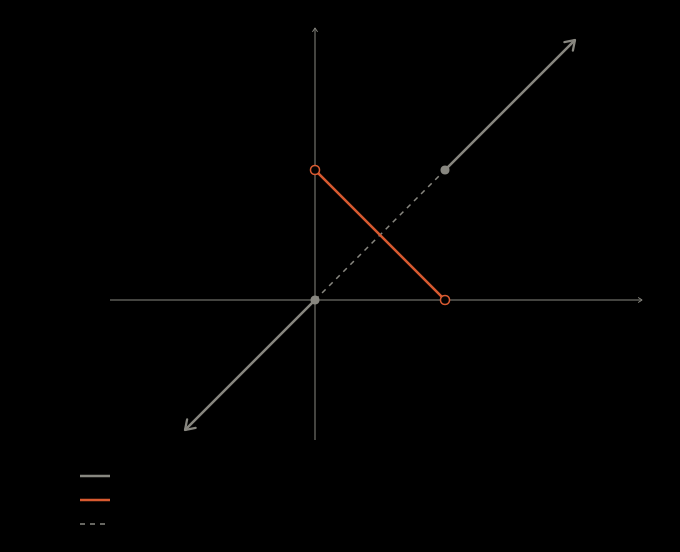
When the outer pieces of a function already cover most of $\mathbb{R}$, a middle piece makes the whole a bijection (일대일대응) only by hitting the leftover gap exactly, each value once. A continuous piece does that by running monotonically from one end of the gap to the other — and backwards works as well as forwards, so the bijection need not be monotone.
Definition
Let $f=h$ outside $(p,q)$, where $h$ is one-to-one with values exactly $\mathbb{R} \setminus (A,B)$, and let $f=g$ on $(p,q)$ with $g$ continuous on $[p,q]$. Then $f$ is a bijection if and only if $g$ is strictly monotone on $(p,q)$ and $g(p)$, $g(q)$ are $A$ and $B$ — in either order.
For a quadratic $g$ with axis $x=v$, monotone on $(p,q)$ means $v \le p$ or $v \ge q$.
Why it holds
Bijective means the pieces' images are disjoint and together cover $\mathbb{R}$, so $g$ must send $(p,q)$ onto exactly $(A,B)$, one-to-one. A continuous one-to-one function on an interval is strictly monotone — a turn would repeat a value by the intermediate value theorem — so its image is the open interval between $g(p)$ and $g(q)$.
For a line or a parabola no continuity theorem is needed. A line's values on $(p,q)$ run straight from $g(p)$ to $g(q)$. A parabola whose axis lies inside $(p,q)$ meets a horizontal line just beyond its vertex twice there, so it is not one-to-one; with the axis outside, it only rises or only falls.
Example
$f(x)=x$ for $x \le 0$ or $x \ge 1$, and $f(x)=1-x$ for $0 < x < 1$. The outer pieces leave the gap $(0,1)$ and the middle piece covers it backwards: $f$ is a bijection, yet it is not monotone and jumps at both joins.
Pitfalls
Trying only the filler that runs the same way as the outer pieces finds half the candidates. When the question asks for a maximum or minimum, the reversed one is often the answer.
The vertex condition keeps its equality: a parabola is strictly monotone on each side of its axis, axis included. Writing $v < p$ drops the boundary case, and a quadratic pinned by three conditions can land exactly there.
"One-to-one implies monotone" needs continuity on an interval; a piecewise $f$ that jumps at the joins escapes it. So does the shortcut "every piece's slope must have the same sign" — it assumes the pieces meet.
See also
A quadratic through two given points is the chord plus $a(x-p)(x-q)$