An increasing function meets its inverse only on $y=x$
Idea
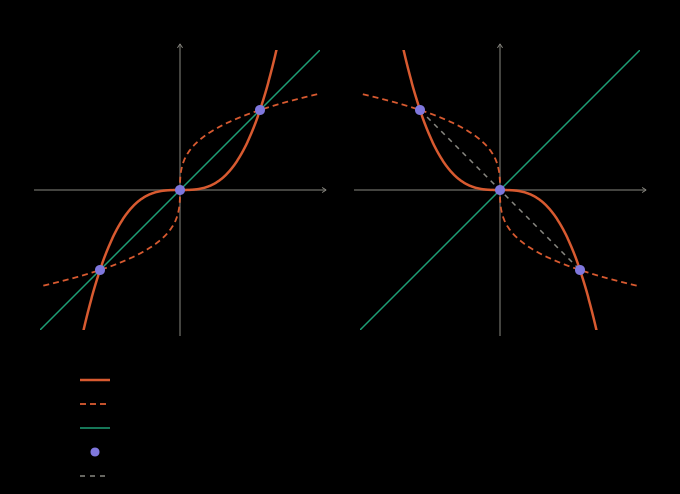
The graph of $f^{-1}$ (역함수) is the mirror image of the graph of $f$ across $y=x$. When $f$ is increasing, the two can meet only on that mirror, so $f(x)=f^{-1}(x)$ is the same equation as $f(x)=x$ — usually a far easier one.
Definition
If $f$ is strictly increasing with inverse $g$, then wherever both are defined
$$f(x)=g(x) \iff f(x)=x.$$
Why it holds
Say $f(p)=g(p)=q$. Then $f(p)=q$, and $g(p)=q$ means $f(q)=p$: both $(p,q)$ and $(q,p)$ lie on the graph of $f$. If $p < q$, then $f(p)=q > p=f(q)$, so $f$ went down — and likewise if $p > q$. Hence $p=q$, that is $f(p)=p$. Conversely $f(p)=p$ gives $g(p)=p$.
Example
$x^3=\sqrt[3]{x}$ cubes to the ninth-degree $x^9=x$, but $x^3$ is increasing, so it is just $x^3=x$: $x=-1, 0, 1$.
Pitfalls
A decreasing $f$ gets no shortcut. $-x^3=-\sqrt[3]{x}$ has the roots $x=0,\pm1$, yet only $x=0$ solves $-x^3=x$: the other two are the mirror pair $(1,-1)$, $(-1,1)$, joined by a chord of slope $-1$ — exactly the chord an increasing $f$ cannot have.
The function must increase on its whole domain. A piecewise $f$ whose pieces each increase, but whose ranges come out of order, can still swap two values.