Two functions are equal when they agree at every point of their domain
Idea
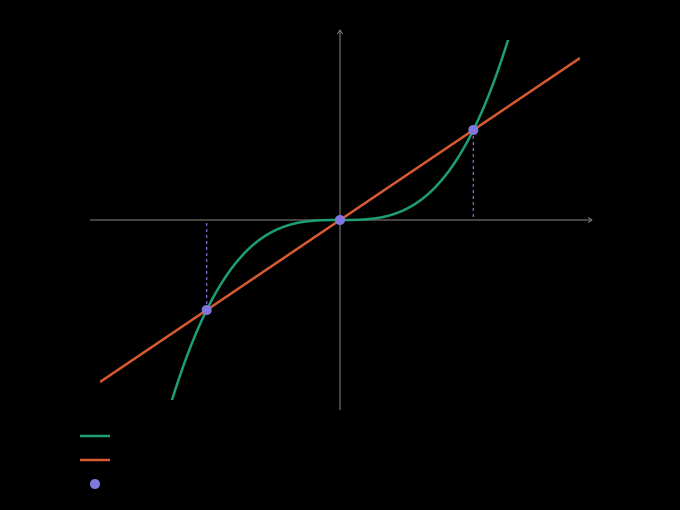
A function is its input–output pairs, not its formula. Two functions with the same domain and codomain are equal (서로 같은 함수) exactly when every input gives the same output — so on a small domain, very different formulas can define the same function.
Definition
$f: X \to Y$ and $g: X \to Y$ are equal, $f = g$, when $f(x) = g(x)$ for every $x \in X$.
On a finite $X = \lbrace x_1, \dots, x_n \rbrace$ that is one equation per element: the two graphs must meet above each $x_i$, and nothing else matters.
Example
On $X = \lbrace -1, 0, 1 \rbrace$, $f(x) = x^3$ and $g(x) = x$ are the same function, since $(-1)^3 = -1$, $0^3 = 0$ and $1^3 = 1$. On $\mathbb{R}$ they differ — at $x = 2$, for one.
Pitfalls
With an unknown element, $X = \lbrace p, q, a \rbrace$, pin the constants with $p$ and $q$ first, then solve $f(a) = g(a)$. That equation already holds at $p$ and $q$, so factor them out as known roots — which is also why such problems add $a \ne p$ and $a \ne q$.
See also
An absolute-value equation solved by cases keeps only the roots inside each case