An absolute-value equation solved by cases keeps only the roots inside each case
Idea
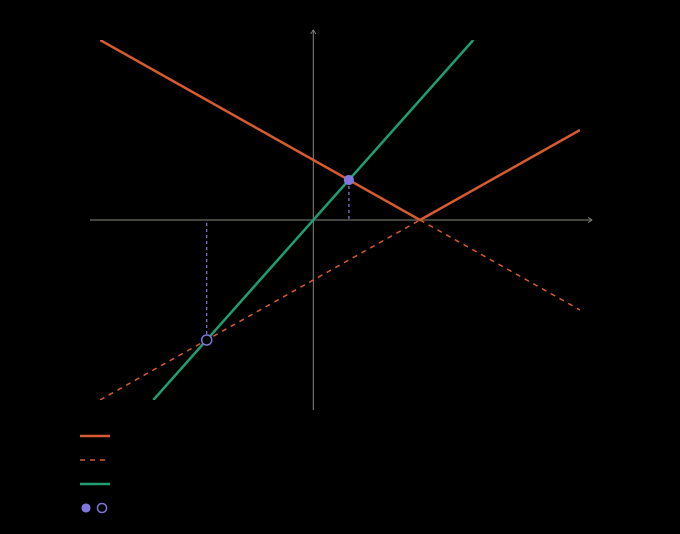
Splitting $|x - c|$ into cases swaps the V for one straight branch at a time, but each case equation solves against that branch's whole line, not just its half. A root on the wrong half is where the other curve meets the dashed extension, not the graph, and it has to be thrown out.
Definition
To solve an equation containing $|x - c|$:
- Case $x \ge c$: replace $|x - c|$ by $x - c$, solve, keep only roots with $x \ge c$.
- Case $x < c$: replace $|x - c|$ by $c - x$, solve, keep only roots with $x < c$.
The solution set is the union of what the two cases keep.
Example
$|x - 1| = 2x$. Case $x \ge 1$: $x - 1 = 2x$ gives $x = -1$, which is not $\ge 1$, so it is rejected. Case $x < 1$: $1 - x = 2x$ gives $x = \tfrac13$, kept. One solution, $x = \tfrac13$.
Pitfalls
Test each root against its own case, not the other one. A root rejected in one case is not a solution at all — it does not move over to the other case.
See also
Two functions are equal when they agree at every point of their domain