A circle tangent to both coordinate axes has center $(\pm r, \pm r)$
Idea
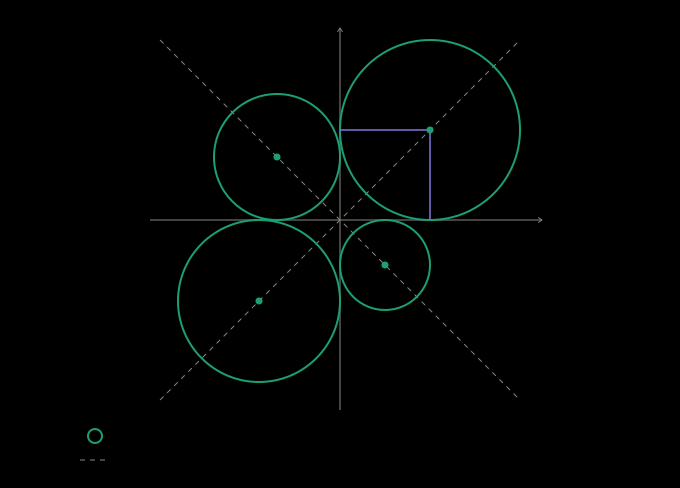
A line is tangent to a circle exactly when the distance from the center to the line equals the radius. For the coordinate axes those distances are just $|y|$ and $|x|$, so "tangent to both axes" collapses three unknowns into one.
Definition
A circle of radius $r>0$ touches both axes if and only if its center $(a,b)$ satisfies $|a|=|b|=r$. The quadrant fixes the signs:
$$\text{I}:(r,r)\quad \text{II}:(-r,r)\quad \text{III}:(-r,-r)\quad \text{IV}:(r,-r)$$
Why it holds
Distance from $(a,b)$ to the $y$-axis ($x=0$) is $|a|$; to the $x$-axis is $|b|$. Tangency to each forces both to equal $r$.
Example
Centers constrained to lie on $(x-1)^2+(y-1)^2=18$:
- Quadrant III, center $(-r,-r)$: $2(r+1)^2=18 \Rightarrow r=2$.
- Quadrant II, center $(-r,r)$: $(r+1)^2+(r-1)^2=2r^2+2=18 \Rightarrow r=2\sqrt2$.
The cross terms cancel in II and reinforce in III, so the two quadrants give genuinely different equations — not the same answer with a sign flipped.
Pitfalls
The center sits on $y=x$ (quadrants I, III) or on $y=-x$ (II, IV), never both, so each quadrant needs its own equation.
Discard roots with $r\le 0$ instead of taking $|r|$: in the example $r+1=-3$ gives $r=-4$, which is not a radius-4 circle somewhere else — it is no circle at all.
See also
An odd solution count across two quadratics pins the parameter at a degenerate case